
Water Damage Equipment Rental
Dehumidifiers, air movers, air scrubbers, desiccants and generators — sized to the IICRC S500 drying standard and delivered as one matched package. Same-day delivery, 24/7 dispatch.
Restoration Equipment Supply rents complete water damage drying packages — LGR and desiccant dehumidifiers, air movers, HEPA air scrubbers, moisture meters and generators — to contractors, property managers and homeowners across NJ, NY, CT, PA, NC, SC and FL. We size each package to IICRC S500, deliver same-day when possible, and dispatch 24/7.
- Desiccant Dehumidifiers
- LGR Dehumidifiers
- Air Movers
- HEPA Air Scrubbers
- Portable Air Scrubbers
- Negative Air Machines
- HEPA Vacuums
- Generators
What equipment do I need for water damage?
Every water damage job needs three things working together: air movers to pull moisture out of wet materials, dehumidifiers to remove that moisture from the air, and enough power to run both around the clock. What changes from job to job is the size of the dehumidifier, the number of air movers, and whether you add HEPA filtration, a desiccant or a generator.
Use the table below as a starting point, then confirm quantities with our IICRC-based equipment calculator or a quick call to dispatch.
| Job type | Core rental equipment | Add when… |
|---|---|---|
| Burst pipe or appliance leak, one or two rooms | 1 LGR dehumidifier + air movers per S500 count | Wet drywall or cabinets: add a moisture meter to track dry standard |
| Finished basement flood | 1–2 LGR dehumidifiers + air movers + HEPA air scrubber | Groundwater or sewer backup (Category 2/3): scrubber is no longer optional |
| Hardwood, plaster, concrete (Class 4 bound water) | Desiccant dehumidifier + low-profile air movers | Cold building or low-grain target: desiccant does the heavy lifting |
| Commercial floor, school, office, retail | Multiple LGRs or a trailer-mounted desiccant + air mover bank | Occupied space: add scrubbers to control dust and odor |
| Hurricane, nor’easter or flood large loss | Trailer-mounted 5,000 CFM desiccant (onboard generator) + air movers + scrubbers | No utility power: add generators for the LGRs and movers |
| New construction or post-flood rebuild drying | Desiccant or high-capacity LGR + axial air movers | Slab or framing must hit target moisture before flooring or drywall goes in |
Drying and restoration equipment we rent
Name brands restoration crews already know — Phoenix, Dri-Eaz, B-Air, XPOWER, AlorAir — pulled from our fleet and sourcing reach and delivered as one package.
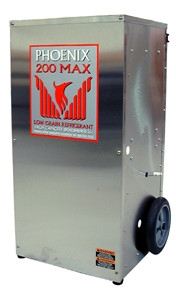
LGR Dehumidifiers
The everyday water damage dehumidifier rental — 64 to 165 AHAM pints per day per unit.
See Dehumidifier Rentals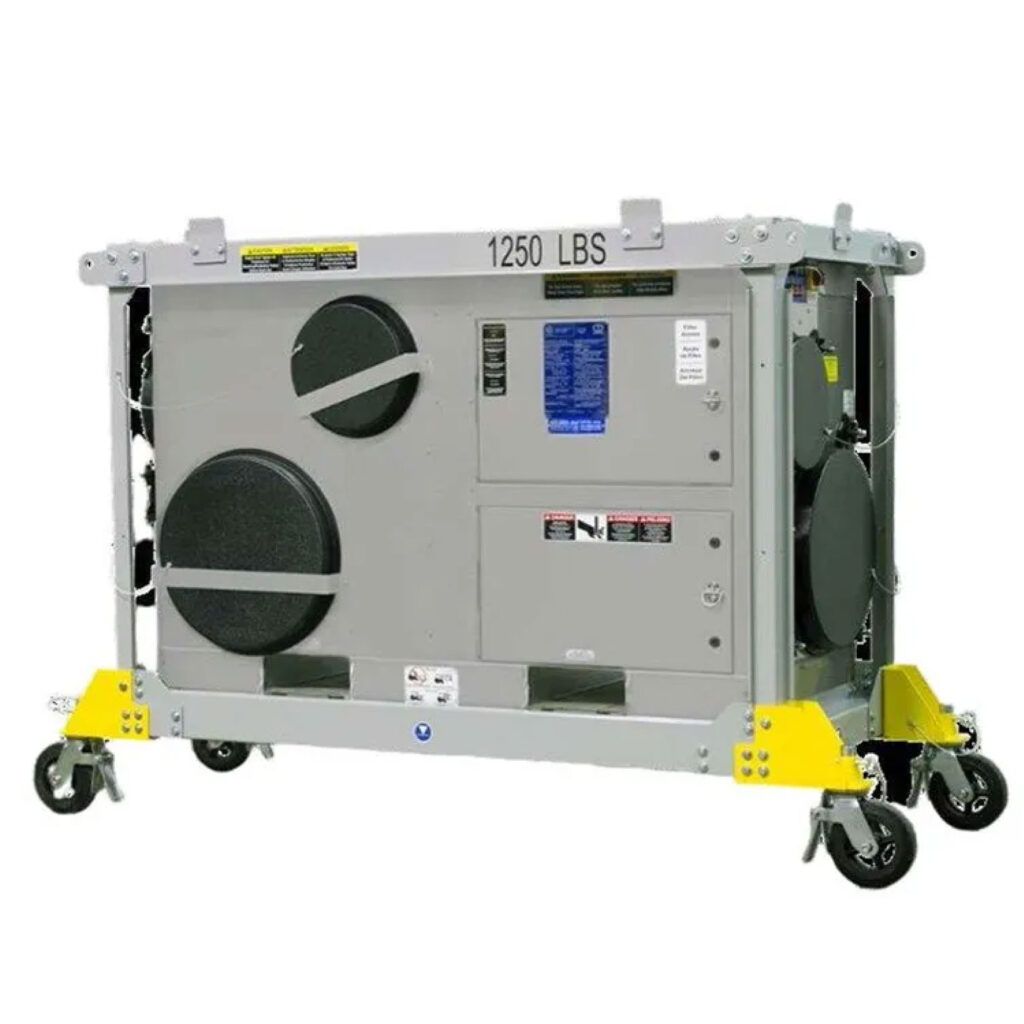
Desiccant Dehumidifiers
Trailer-mounted 5,000 CFM with onboard power for big, cold or bound-water jobs.
See Desiccant Rentals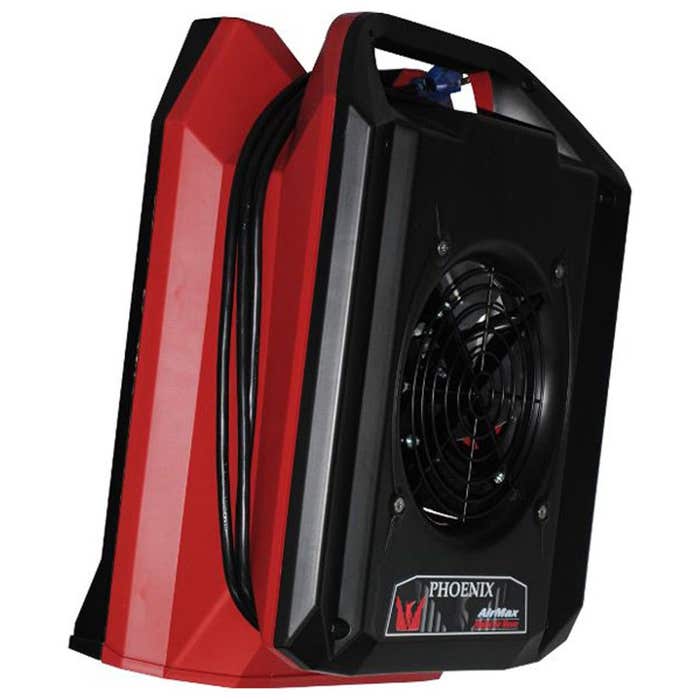
Air Movers
Centrifugal, low-profile and axial drying fans that daisy-chain on one circuit.
See Air Mover Rentals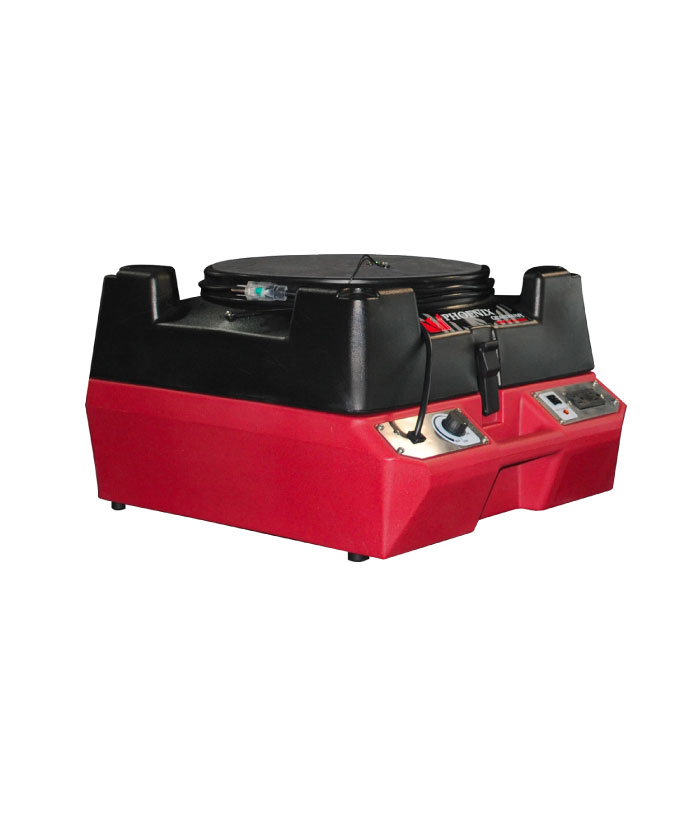
HEPA Air Scrubbers
Captures dust, spores and odor that air movers kick up on Category 2 and 3 losses.
See Air Scrubber Rentals
Build a Package
Instant air mover count and dehumidifier size from your room dimensions.
Open the Sizing CalculatorBrowse every model with specs in our full rental inventory. Running a large building? See our commercial dehumidifier rental options.
How does water damage drying actually work?
Water damage drying works by moving moisture from wet materials into the air, then out of the building. Air movers speed evaporation at the surface, dehumidifiers capture that water vapor before it re-absorbs into drywall and framing, and controlled temperature keeps evaporation going. Remove any one of those and drying stalls.
The IICRC S500 Standard for Professional Water Damage Restoration is the reference the industry and most insurers use. It sorts every loss two ways: by category (how contaminated the water is) and by class (how much water there is to evaporate).
IICRC S500 water categories
- Category 1 — clean waterSupply lines, faucets, rain. Can degrade to Category 2 if left standing.
- Category 2 — significant contaminationWashing machine or dishwasher discharge, toilet overflow with urine, aquarium water.
- Category 3 — grossly contaminatedSewage, rising flood water, seawater, ground water. Porous materials are removed, and HEPA filtration and PPE are expected.
IICRC S500 water classes
- Class 1Least water: a small share of the room’s surfaces wet, mostly low-porosity materials.
- Class 2Significant water: carpet, pad and lower walls wet; the most common residential loss.
- Class 3Greatest amount: wet ceilings, walls, insulation and floors, often from overhead.
- Class 4Bound water in dense materials — hardwood, plaster, concrete, masonry. Needs low humidity and time; a classic desiccant job.
How many air movers do I need for water damage?
Plan one air mover for each wet room, plus one for every 50–70 square feet of wet floor, plus one for every 100–150 square feet of wet wall above two feet, plus one for each wall offset or inset over 18 inches. That is the IICRC S500 starting-point method our calculators use; a technician then adjusts by reading the materials.
Worked example: one 20 × 25 ft room with 500 sq ft of wet carpet needs 1 (room) + 500 ÷ 70 to 500 ÷ 50 (floor), or roughly 9 to 11 air movers before counting wet walls. Run the numbers for your rooms with the air mover calculator.
Mind the circuit. A 15-amp circuit gives you about 12 usable amps under the 80% continuous-load rule. A Phoenix AirMAX radial mover draws 1.9 A and a Phoenix 200 MAX LGR draws 7.4 A, so one LGR plus two movers (11.2 A) is a full circuit. Big jobs need multiple circuits or a properly sized generator.
| Model | Type | Max airflow | Amps | Best for |
|---|---|---|---|---|
| Phoenix AirMAX Radial | Low-profile radial | 925 CFM | 1.9 A | Carpet, under cabinets; up to 6 on one 15 A circuit |
| Phoenix Focus II | Dual axial | 1,015 CFM | 1.1 A | Long hallways, open floors; up to 10 per 15 A circuit |
| B-Air Vent VP-33 | Centrifugal | 2,530 CFM | 2.6–2.9 A | Walls, wall cavities, general drying |
| Dri-Eaz Sahara Pro X3 | Centrifugal | 2,700 CFM | 3.0–4.0 A | High static pressure, duct-fed cavity drying |
What size dehumidifier do I need for water damage?
Divide the cubic feet of the drying area by the S500 chart factor for your water class to get the AHAM pints per day you need, then add units until you reach it. For desiccants, multiply cubic feet by the target air changes per hour and divide by 60 to get the process CFM.
Worked example: a 20 × 25 × 8 ft basement is 4,000 cubic feet. As a Class 2 loss with an LGR, 4,000 ÷ 50 = 80 AHAM pints per day — one Phoenix 200 MAX (133 AHAM pints) covers it with headroom. Size yours with the dehumidifier sizing calculator.
| Water class | Conventional refrigerant | LGR | Desiccant |
|---|---|---|---|
| Class 1 | cu ft ÷ 100 | cu ft ÷ 100 | 1 air change per hour |
| Class 2 | cu ft ÷ 40 | cu ft ÷ 50 | 2 air changes per hour |
| Class 3 | cu ft ÷ 30 | cu ft ÷ 40 | 3 air changes per hour |
| Class 4 | Not recommended | cu ft ÷ 40 | Preferred for bound water |
Pints, AHAM and grains: reading a dehumidifier spec
AHAM pints per day is capacity at a standard 80°F and 60% RH test condition — the number to size with. Saturation pints (90°F, 90% RH) is always much higher and mostly marketing; the Dri-Eaz LGR 7000XLi is rated 130 AHAM pints but 235 at saturation. Restorers track progress in grains per pound (GPP), the actual weight of water in the air. An LGR keeps pulling water at lower grain levels than a home unit; a desiccant keeps going lower still, and in cold air where coils stop condensing.
24/7 Emergency Dispatch
Water on the Floor
Right Now?
Same-day emergency delivery. A real person answers, never a machine.
(973) 685-4030- Dispatch 24/7
- Same-Day Emergency Delivery
- Delivered, Set & Monitored
Air movers vs. LGR vs. desiccant: what does each do?
Air movers evaporate, dehumidifiers capture, and the dehumidifier type decides how dry you can get. Most jobs rent movers plus LGRs; large, cold or Class 4 jobs step up to a desiccant.
| Equipment | What it does | Example unit | Rated capacity | Choose it when |
|---|---|---|---|---|
| Air mover | Pushes high-velocity air across wet surfaces to speed evaporation | B-Air Vent VP-33 | 2,530 CFM | Every water loss |
| LGR dehumidifier | Refrigerant coil that pulls water from air to lower grain levels | Phoenix 200 MAX LGR | 133 AHAM pints/day, 265 CFM, 7.4 A | Most residential and light commercial jobs above about 33°F |
| Portable desiccant | Silica-gel wheel adsorbs moisture; works cold and at low humidity | Phoenix D385 | 385 CFM, 130 AHAM pints/day, −10°F to 140°F | Hardwood, crawlspaces, cold buildings |
| Trailer desiccant | High-CFM desiccant with onboard generator | Titan HE 5000 class | 5,000 CFM, 158 lb/hr (AHAM), 27 kW onboard diesel | Large commercial, flood and disaster drying with no power |
Deep dive on the flagship: trailer-mounted desiccant dehumidifier rental. For everyday units, see LGR dehumidifier rental.
How does renting water damage equipment work?
Call or send the form, we size the package, and it arrives ready to plug in. Five steps from first call to return.
Tell Us the Loss
Call (973) 685-4030 any hour or request a quote. Share square footage, ceiling height, water source and what got wet.
We Size to S500
Dispatch matches air movers, dehumidifiers, scrubbers and power to the class and category — no guessing.
Same-Day Delivery
Equipment comes from the nearest staging point, often same-day for emergencies across our service states.
Monitor and Adjust
Take daily moisture and GPP readings. Add, swap or pull units with one call as the job dries down.
Reach Dry Standard, Return
When materials hit their dry goal, call for pickup. Daily, weekly and monthly terms available.
Where is water damage equipment used?
From a single flooded basement to a hurricane-hit hotel, the drying chain is the same — only the scale changes.
Residential
Burst pipes, water heater failures, basement and crawlspace floods. LGRs and low-profile movers that run quietly in occupied homes.
Commercial Drying
Offices, schools, retail and multifamily. Commercial drying equipment rental scales to dozens of movers, multiple LGRs or a trailer desiccant.
Flood & Disaster
Disaster equipment rental for hurricanes, nor’easters and river flooding, with grid-independent desiccants and generators when the power is out.
Construction Drying
Dry slabs, framing and plaster on schedule so flooring and finishes don’t fail. Desiccants keep working through winter.
Most water losses that sit untreated turn into mold work. If growth is already visible, start with our mold remediation equipment rental guide for containment and negative air. We deliver across New Jersey, New York, Florida and the rest of our service areas.
Water Damage Equipment Rental FAQ
Where can I get water damage restoration equipment rental near me?
Restoration Equipment Supply delivers water damage restoration equipment across New Jersey, New York, Connecticut, Pennsylvania, North and South Carolina and Florida from Piscataway, NJ and staging points in our service area. Call (973) 685-4030 for same-day delivery when available, or check your area.
Can I rent drying and restoration equipment as a homeowner?
Yes. We rent drying equipment to homeowners, property managers and restoration contractors. We size the package to your rooms and deliver it, so you don’t have to guess how many fans or which dehumidifier to rent.
What is the best dehumidifier for water damage rental?
For most homes and light commercial jobs, an LGR dehumidifier rated 64–165 AHAM pints per day is the right water damage dehumidifier rental. For hardwood, plaster, concrete, cold buildings or very large spaces, rent a desiccant dehumidifier.
How many rental fans do I need for water damage?
Start with one air mover per wet room, plus one per 50–70 sq ft of wet floor and one per 100–150 sq ft of wet wall above two feet, per IICRC S500. A typical 500 sq ft wet room needs about 9–11. Use the air mover calculator for your exact count.
Can I rent fans for water damage without a dehumidifier?
Not recommended. Fans alone push moisture into the air, where it soaks back into drywall and framing and raises mold risk. Always pair water damage fan rentals with enough dehumidification to capture what they evaporate.
What is mitigation equipment?
Mitigation equipment is the gear used to stop water damage from getting worse: extraction tools, air movers, dehumidifiers, HEPA air scrubbers, moisture meters and temporary power. We rent all of it as matched mitigation packages.
Do you offer commercial drying equipment rental and disaster equipment rental?
Yes. Commercial and disaster jobs get multiple LGRs or trailer-mounted 5,000 CFM desiccants with onboard generators, large air mover banks, scrubbers and generators, delivered through our fleet and sourcing reach and dispatched 24/7.
How long should I rent water damage equipment?
Rent until materials reach their dry standard, not for a set number of days. Many Class 1 and 2 losses dry in a few days with the right equipment; Class 4 materials take longer. EPA advises drying wet materials within 24–48 hours to prevent mold, so start fast.
Updated October 2026 · Reviewed by the Restoration Equipment Supply dispatch team · Sources: IICRC S500, U.S. EPA, Ready.gov flood guidance, manufacturer spec sheets.
Water damage equipment rental is sized to the job by our dispatch team, so you rent what the loss needs and nothing extra.
Questions about water damage equipment rental? Call (973) 685-4030 and a real person answers 24/7.
We stage every water damage equipment rental order so it ships tested, cleaned and ready to run.
Get Your Free
Rental Quote
Tell us about the water loss — rooms, square footage, what got wet — and we’ll stage a matched drying package for delivery. A real person answers, any hour.
📞 (973) 685-4030Request a Quote
Fast response, 24/7. No obligation.